
What and why are we measuring?
Air quality concerns related to dust depend on the size and chemistry of the particles. We focus on particulate matter (PM), which are tiny pieces of dust in the air and the metals contained in the dust.
Inhalable and respirable dust
Airborne dust mostly consists of PM less than 10 microns (PM10) and less than 2.5 microns (PM2.5). Both forms are inhalable, with larger particles being trapped in your nose and expelled while finer particles accumulating deep in your respiratory system, potentially causing harm.
Heavy metals
Naturally occurring and industrially sourced heavy metals that may reside in dust and are health concerns depending on specific concentrations (such as arsenic, cadmium, cobalt, copper, lead, mercury, and thallium).
How we are measuring dust: Utah Dust Observation and Research Network
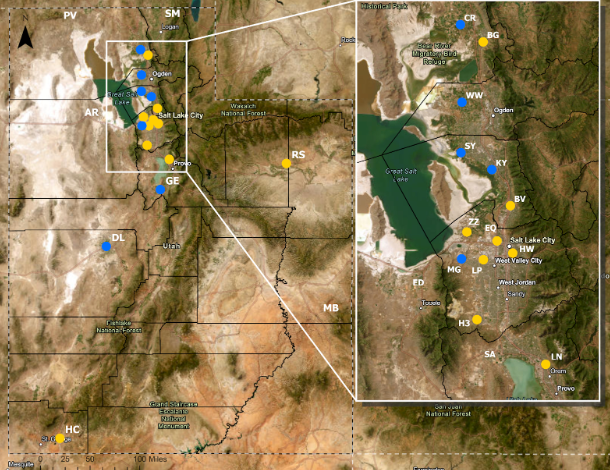
Our new Utah Dust Observation and Research Network (UDORN) captures dust events primarily in Wasatch Front communities and will operate for at least the next five years. UDORN offers the unprecedented opportunity to track dust, identify heavy metal contamination in blowing dust, and uncover potential health risks associated with urban dust deposition.
Projects at a glance
For residents along the Wasatch Front, wind-driven dust is a visible and recurring environmental concern. While we have long monitored particulate matter concentrations, we recognize that “how much” dust is in the air is only part of the story. To provide a more comprehensive narrative, we are launching three data-driven initiatives to identify the sources, frequency, and chemical composition of dust in Utah.
Tracking dust events state-wide in near real-time
We are expanding our PM monitoring infrastructure to include approximately 23 stations capturing dust events and heavy metals falling on residential communities.
Developing a dust event legacy database
We are identifying the extent GSL water levels and climate variability are altering dust over the last twenty-five years to forecast air quality.
Generating a dust metals inventory
We are measuring the heavy metal concentrations in dust across multiple communities as far back as 2010 to provide an accurate, transparent dialogue of dust-adjacent air quality concerns for all Utahns.
Latest research updates
Application & data support
Zacahary Aanderud
Dust Scientist & Coordinator
[email protected]
Contact for technical inquiries regarding Great Salt Lake dust and other dust research efforts.
Reporting immediate concerns?
If you see dust clouds coming from a construction site, gravel pit, or industrial facility, please use our dust compliance report form.