Division of Air Quality
Northern Wasatch Front Ozone Nonattainment Area
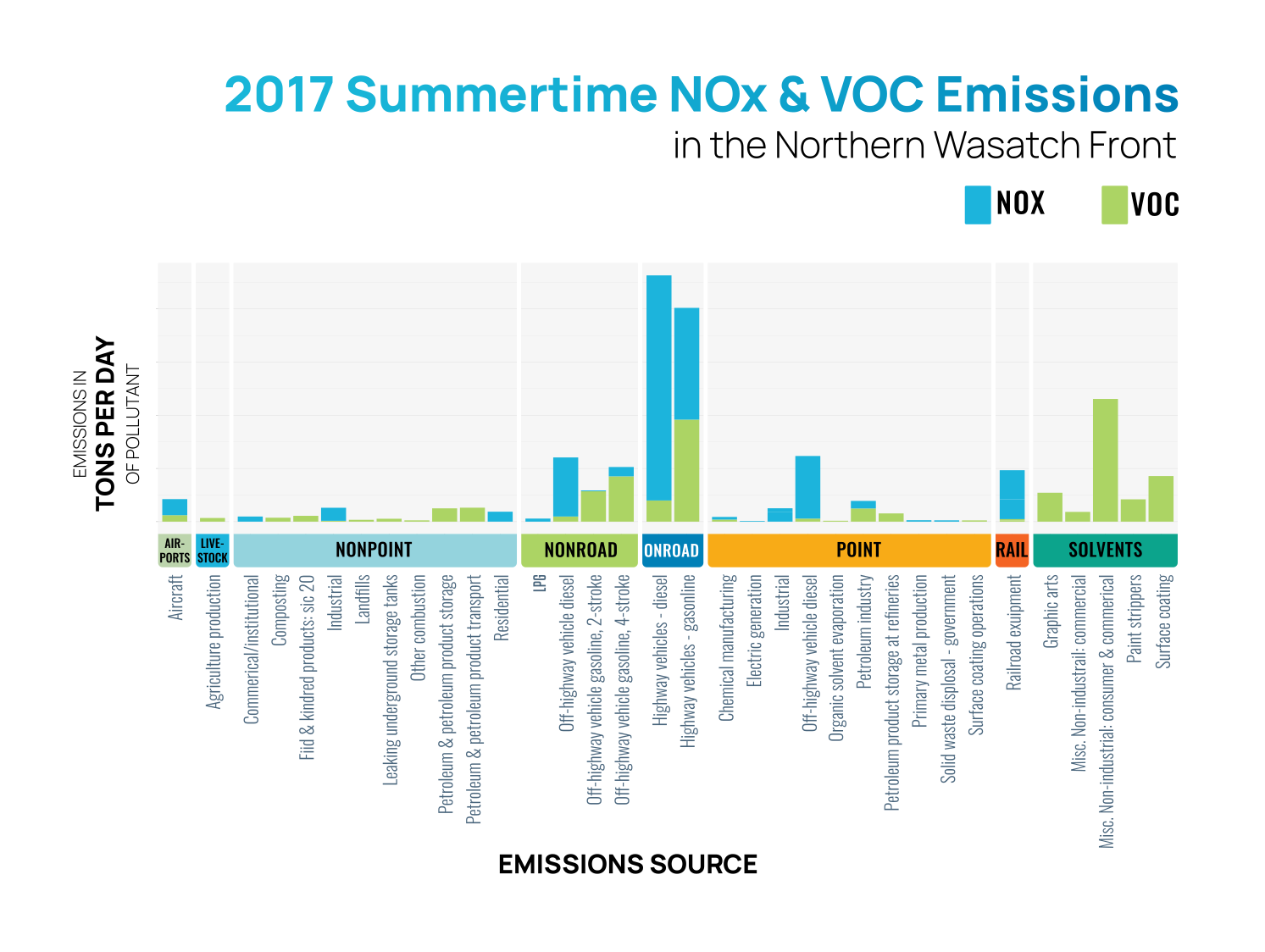
This page contains information about summertime ozone in the Northern Wasatch Front nonattainment area and an interactive emission inventory for the area. You can use thisInteractive Inventory to explore and learn about different emission sectors and sources (SCCs) within the Northern Wasatch Front, and where the emissions originate that drive the local ozone formation.
What is summertime ozone?
You’re probably familiar with the Wasatch Front’s wintertime PM2.5 pollution, but Utah’s urban center also experiences harmful air pollution – ozone – during the summertime. Ozone is a highly reactive gas that causes damage to human lung tissue. Ground-level ozone is generated when precursor pollutants – Volatile Organic Compounds (VOCs) and Oxides of Nitrogen (NOx) – interact with sunlight. The Northern Wasatch Front region experiences ozone concentrations that exceed Environmental Protection Agency’s (EPA) air quality thresholds.
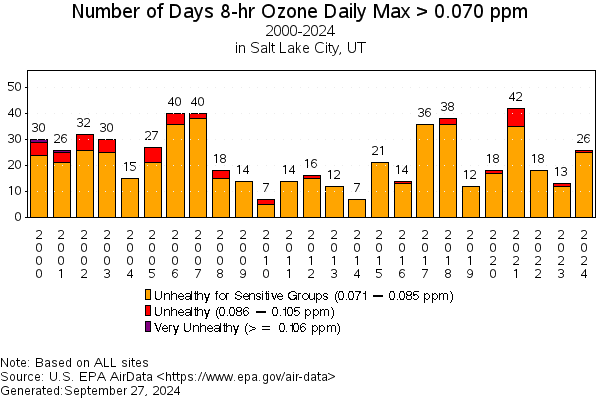
Source
The Northern Wasatch Front Nonattainment Area
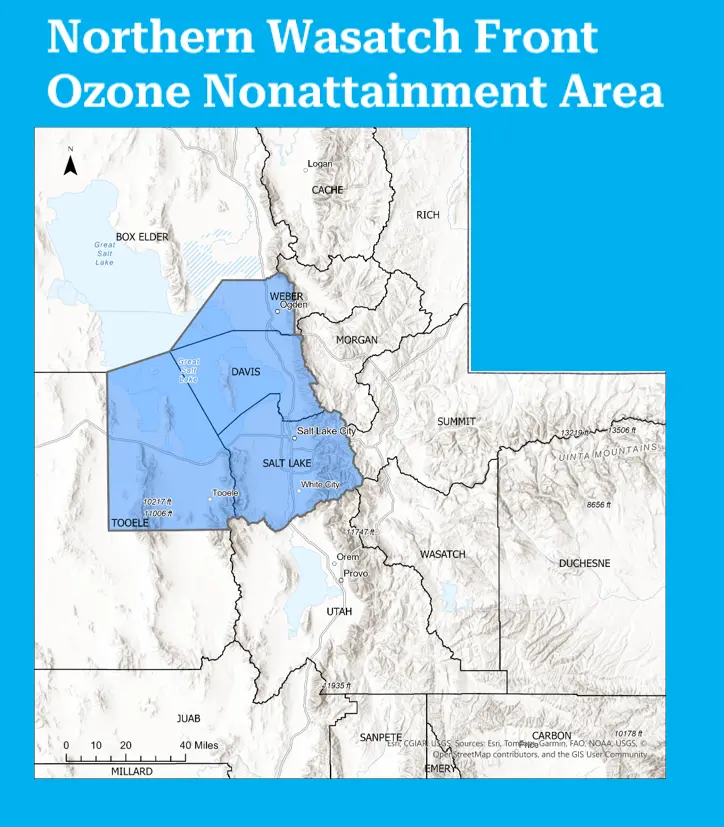
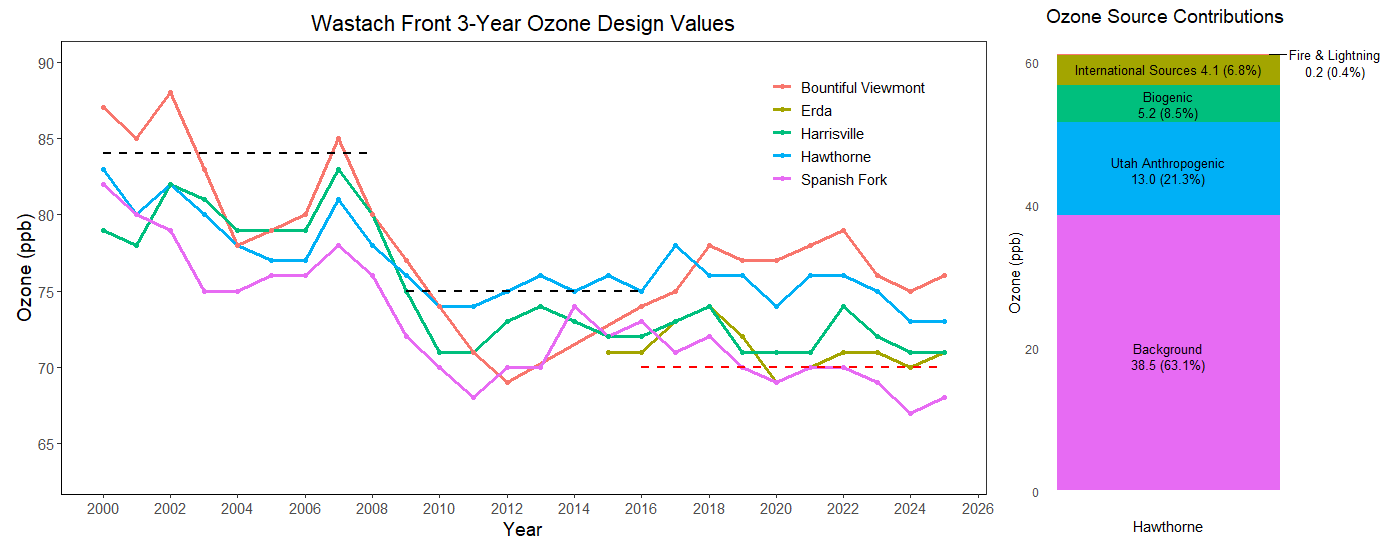
In August 2018, the EPA designated areas of the Wasatch Front as a nonattainment area for ozone based on the 2015 National Ambient Air Quality Standard of 70 ppb. The area includes Salt Lake, Davis, as well as portions of Weber and Tooele counties. Since the Northern Wasatch Front failed to meet the 70 ppb threshold by August 2021, the area was reclassified to “Moderate” nonattainment status. As part of this designation, Utah was required to develop and submit a moderate State Implementation Plan (SIP), which included a description of how the state reduced emissions in order to meet the air quality standard.
However, as the area failed to attain the standard by the moderate attainment date of August, 2024, the area may be further redesignated as a “Serious” nonattainment area. As a result of this more stringent designation, the state will again need to develop a serious SIP amendment showing how the state will further reduce NOx and VOC emissions throughout the nonattainment area. If the area is redesignated to serious status, a new SIP will be due to the EPA on January 1, 2026.
FAQs

MAPS: Ozone-forming pollutant sources in Utah
Sources of ozone precursor emissions range from vehicles to industrial mining operations, from leaf blowers to oil refineries. Learn more about the sources of pollution that cause ozone formation in your legislative district using the interactive maps.
Emissions are from the Division of Air Quality’s 2017 emissions modeling platform.
Questions?
Ryan Bares ([email protected])
Lexie Wilson ([email protected])